The Longest Goodbye: Finding Grit and Grace in the Alzheimer’s Journey

Yesterday, the world went quiet for a friend of mine.
Her father is gone.
The news was a heavy blow, but it wasn’t a surprise.
In the world of Alzheimer’s, the end is rarely a surprise.
It is the final period at the end of a very long, very exhausting sentence.
We call it the "Longest Goodbye."
Because when you love someone with Alzheimer’s, you don’t just lose them once.
You lose them in pieces.
You lose them in fragments.
You lose them over years of dinner conversations that lead nowhere and eyes that no longer spark with recognition.
To my friend: I see you.
To those currently walking this path: I see you.
This is the intersection of grit and grace.
This is where the soul is forged.
The Thief in the Room
Alzheimer’s is a thief that doesn’t take everything at once.
It’s a slow erosion.
It starts with keys.
Then it moves to names.
Then it takes the stories: the very fabric of who a person is.
I’ve seen this theft firsthand.
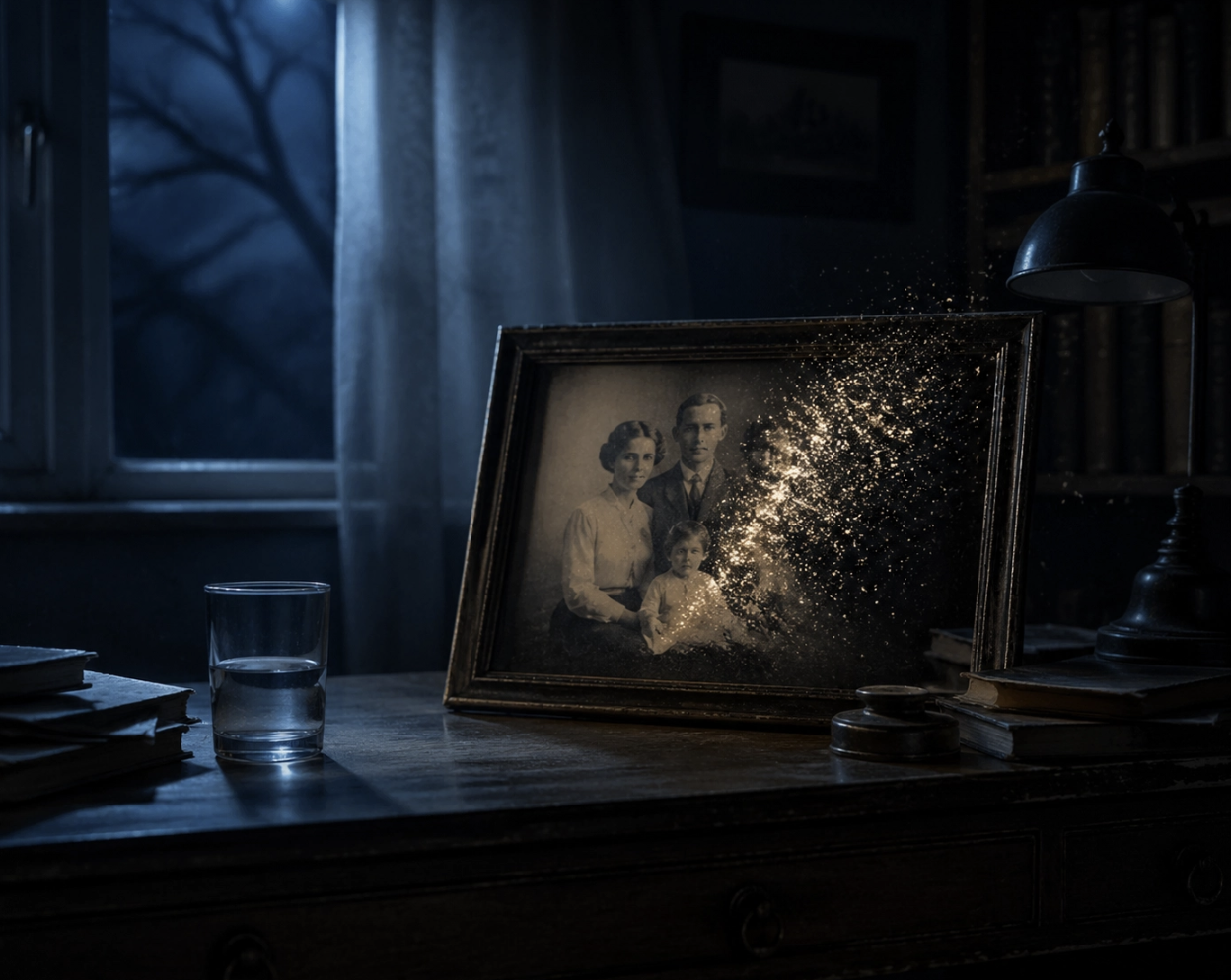
I’ve watched the light behind the eyes dim until it’s just a flickering candle in a vast, dark room.
For the family, this is the first death.
It is the death of the relationship as you knew it.
The father who taught you how to drive.
The man who gave you away at your wedding.
The person who held the history of your family in his hands.
He becomes a stranger with a familiar face.
That is a specific kind of agony.
It is a grief that has no place to land because the person is still physically there.
You are mourning a ghost who is still breathing.
The Grit of the Caregiver
We talk a lot about grit at REAL GRIT COMPANY.
Usually, we talk about it in the context of business, or the gym, or the front lines of emergency service.
But there is no grit more profound than the grit of a caregiver.
It is the quietest kind of courage.
It is the courage to show up every single day to a job that offers no rewards and no "thank yous."
It is the grit to stay patient when you’ve been asked the same question fourteen times in ten minutes.
It is the strength to keep your voice steady when your heart is breaking.
Caregiving is built, not born.
It is sculpted out of exhaustion.
It is tempered in the fire of frustration and love.
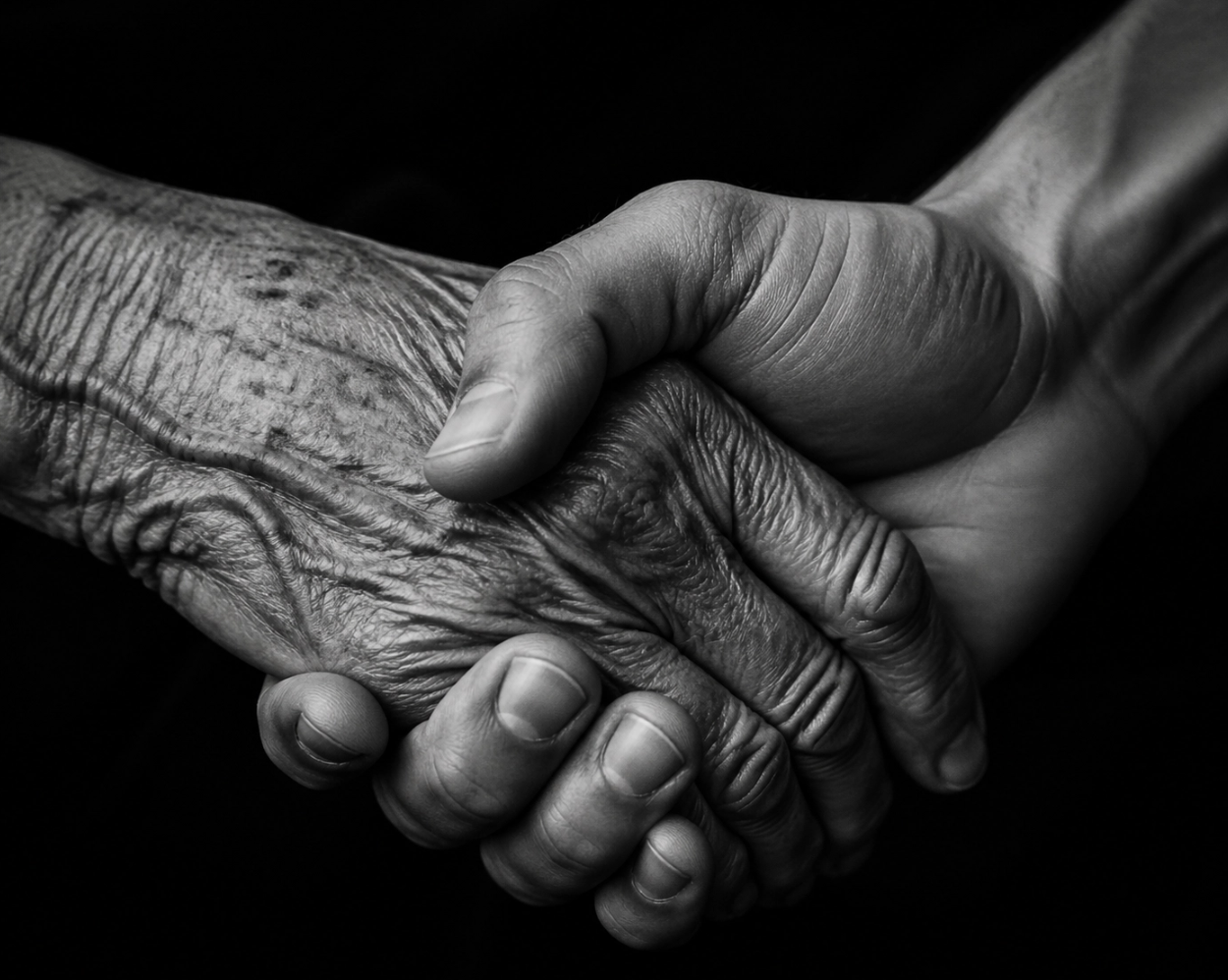
I’ve held the hands of those who are tired to their marrow.
I’ve watched the toll it takes on the body and the mind.
The world sees the patient.
We see the caregiver.
We see the weight you carry.
And we know that strength through adversity is not just a slogan.
It is your daily reality.
The Binary of the Journey
In this journey, you live in the tension of opposites.
Love vs. Loss.
Duty vs. Despair.
Present vs. Past.
You are tethered to the person they were, while being forced to care for the person they are.
It requires a level of emotional gymnastics that would break most people.
You have to find a way to honor the legacy of the man who was strong, while protecting the man who is now fragile.
My friend did this with an intensity that can only be described as grace.
She stood in the gap.
She became the keeper of his memories when his own mind let them go.
She became his anchor when he was adrift.
That is not just "looking after" someone.
That is holy work.
That is the definition of The Real Grit Difference.
The Second Death
Then comes the second death.
The physical departure.
For many, there is a complicated mix of emotions.
There is the crushing weight of finality.
But there is also, often, a whisper of relief.
Relief that the struggle is over.
Relief that the person is no longer a prisoner of their own failing biology.
And then comes the guilt for feeling that relief.
If you are feeling that today, hear me:
Drop the guilt.
The relief is not a lack of love.
The relief is the final act of compassion.
It is the recognition that the "Long Goodbye" has finally reached its destination.
You have carried the burden as far as it could be carried.
You have earned the right to lay it down.
Death is the end of the disease, not the end of the love.
The person you lost years ago is finally, in a way, returned to you.
The fog has cleared.
The memory of who they really were can finally take center stage again.
Finding the Community
No one should walk this path alone.
The isolation of caregiving is a silent killer.
It pulls you away from your friends.
It pulls you away from your hobbies.
It pulls you away from yourself.
Finding support for caregivers is the only way to survive the marathon.
There is a unique strength found in the caregiver community.
It is a community of people who understand the "3 AM panic."
People who understand the grief of the "first death."
People who know that sometimes, "fine" is a lie we tell to get through the grocery store line.
At REAL GRIT, we believe in the power of the collective.
We believe that shared burdens are lighter.
We believe that your story matters, even the parts that are messy and raw.
Especially those parts.
A Tribute to a Life Lived
To my friend’s father:
You were more than this disease.
You were a life.
A legacy.
A source of strength for your family.
The disease tried to erase you, but it failed.
It failed because of the woman you raised.
It failed because your story is written in her heart.
It failed because love does not have a shelf life.
You are free now.
The fog is gone.
The memory is restored.

To the Caregivers Left Behind
When the journey ends, the silence can be deafening.
The schedule that was once dominated by medications and appointments is suddenly empty.
The house feels different.
The air feels different.
This is the time to rebuild.
This is the time to reclaim the parts of yourself that you set aside to serve another.
It won’t happen overnight.
You are battle-worn.
You are weary.
But you are also stronger than you were when this started.
You have a grit that is deep-seated and immovable.
You have a grace that was earned in the trenches.
Take your time.
Breathe.
Remember.
Resources for the Journey
If you are in the thick of it now — or standing in the quiet after — there are places that can help carry some of the weight.
You do not have to white-knuckle this alone.
The road is heavy enough.
Alzheimer’s Association — 24/7 Helpline: 800-272-3900
HFC (Hilarity for Charity) — for caregiver support groups and respite grants
Our own Caregiver Reset post for tactical emotional survival
The Final Word
Alzheimer’s is a thief, but it is not a victor.
It can take the mind, but it cannot take the impact a person had on the world.
It cannot take the lessons they taught.
It cannot take the love they gave.
We honor the fallen by how we carry ourselves forward.
We honor them by living with the same resilience they would have wanted for us.
We honor them by finding the strength to say "goodbye" one last time.
And then, we keep going.
Because that is what we do.
That is who we are.
Grit. Grace. Legacy.
Shift Work Sanity: Stress Busters for Nurses
The fluorescent lights hum.
The coffee is somehow already cold.
And somebody, somewhere, has just said, “It’s quiet tonight.”
Which is basically a medical emergency by itself.
If you’re a nurse, you know the vibe.
Half caffeine.
Half instinct.
Half pure stubbornness.
Yes, that’s three halves.
That’s shift math.
You walk through those double doors with your badge, your brain, and whatever emotional stability survived the group text.
You carry a lot.
Patients.
Families.
Charting.
Three pens, none of which are yours.
And somehow you’re expected to keep smiling while your compression socks are fighting for their lives.
I’ve stood in those hallways.
I know the pace.
I know the chaos.
I know the special kind of nonsense that shows up when it’s a full moon, two people called out, and the printer suddenly decides it, too, has limits.
So no—this isn’t about pretending stress doesn’t exist.
And it’s not about some perfect wellness routine that requires eight free hours and a lemon-water personality.
This is about real stress relief for real nurses.
Practical.
Quick.
Actually doable.
Because sometimes resilience looks inspiring.
And sometimes it looks like eating string cheese over the sink at 2 a.m. and calling that a win.
Honestly... fair.
The Quiet Before the Grind
The shift starts long before you clock in.
It starts in the weird little pre-shift window where you are still a person and not yet the keeper of twelve call lights and one suspiciously beeping machine.
Most people launch straight into the day.
No buffer.
No plan.
No caffeine strategy.
Dangerous.
You need a small routine.
Nothing dramatic.
Just five minutes that belong to you before the shift starts taking pieces.

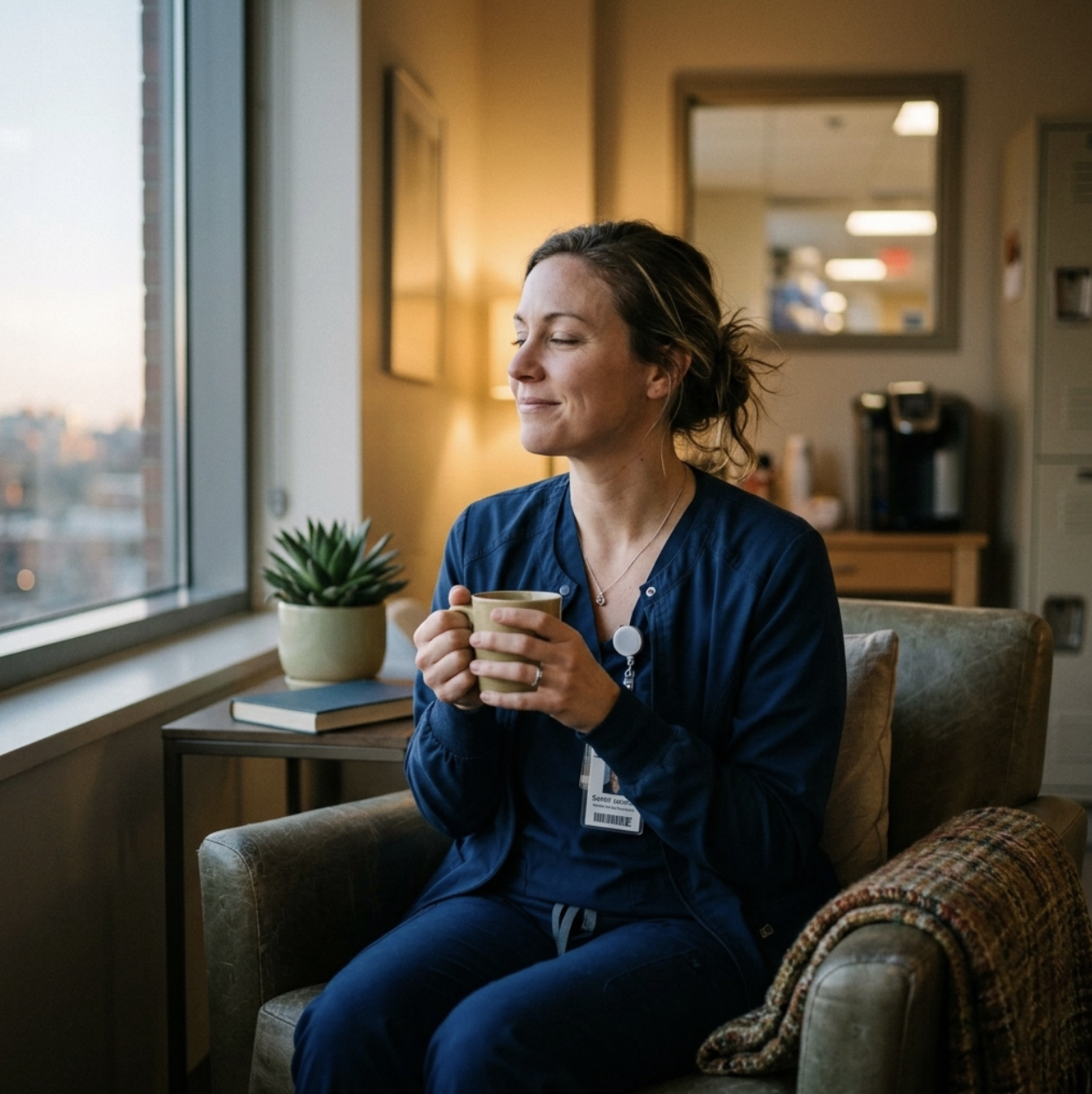
Sit with your coffee.
Or your tea.
Or your emotional support iced drink.
Don’t scroll.
Don’t check work messages.
Don’t let the chaos clock in before you do.
Take a few slow breaths.
Stretch.
Look out the window.
Mentally prepare for the possibility that you will not pee for six hours and someone will still ask if you’ve “got a quick second.”
This matters more than it sounds.
A short pre-shift ritual can lower stress, help you focus, and keep you from starting the day already overstimulated.
Five calm minutes now can save you from becoming a feral raccoon by noon.
Start steady.
Stay steady.
The Quiet Before the Grind
The shift starts long before you clock in.
It starts in the quiet.
In the minutes where you are still just a person, not yet a provider.
Most people rush.
They stumble out of bed, chase the clock, and arrive at the bedside already out of breath.
Don’t do that.
You need an anchor.

Find five minutes.
Just five.
Sit with your coffee.
Feel the heat of the mug against your palms.
I’ve watched the strongest people I know crumble because they forgot how to breathe before the storm.
Preparation is a ritual.
It is how we rebuild the walls before they are tested.
Research tells us that 92% of nurses rate their stress as moderate to high.
That is nearly everyone in the room.
If you don't anchor yourself, you are just another leaf in the wind.
Use those five minutes for intentionality.
Not scrolling.
Not checking the news.
Just being.
Forged in silence.
Full Moon Protocol
Let’s address the ancient healthcare truth nobody can scientifically prove and yet every nurse knows in their bones:
the full moon is a menace.
You can feel it before you even clock in.
The air gets weird.
The call lights multiply.
The vending machine starts looking judgmental.
And someone—always someone—has the nerve to say the forbidden Q word.
Quiet.
We do not say that here.
Not in the hall.
Not at the desk.
Not even as a joke.
The second it leaves somebody’s mouth, the whole hospital shifts into low-budget paranormal movie mode.
Suddenly the ED is full of “interesting” characters.
A man in one flip-flop is yelling at a ceiling tile.
A patient insists the television is speaking directly to them.
Family drama unfolds in real time like a cable reality show with worse lighting.
Telemetry is alarming.
Nobody knows why.
A stretcher appears in the hallway with no clear origin story.
Even the automatic doors start opening like they’ve seen something.
And the staff?
The staff gets that thousand-yard stare that says, “If one more bizarre thing happens, I will simply float into the vents.”
This is when stress relief becomes less of a wellness concept and more of a survival skill.
On full moon shifts, lower the bar and tighten the system.
Hydrate early.
Eat when you can.
Double-check your humor reserves.
Text your work bestie.
Take the thirty seconds.
Take the bathroom break.
Take the deep breath before entering the room where something absolutely strange is definitely happening.
You are not imagining it.
The vibes are off.
The moon is loud.
And the hospital has, once again, become lightly haunted.
Protect your peace.
And never say quiet.
The Thirty-Second Sanctuary
Nursing is basically a triathlon nobody trained for.
Chart.
Walk fast.
Answer questions.
Chart again.
Somewhere in there, hunt down supplies that were definitely here five minutes ago.
Your stress builds fast.
Your shoulders climb to your ears.
Your brain starts opening seventeen tabs at once.
That’s your cue.
Take a thirty-second reset.
Not a full break.
Not a spa day.
Just a tiny nervous-system reboot before you go into the next room pretending you absolutely remember your fourth password reset this week.
Wash your hands.
Feel the water.
Take three slow breaths while the soap does its thing.
Drop your shoulders.
Unclench your jaw.
Let the last interaction stay in the last room.
That part matters.
One hard patient.
One hard family conversation.
One chaotic moment.
It all stacks up.
These mini-pauses help interrupt that stress pileup before it turns into full-shift crankiness, tears in the supply closet, or a personal feud with the WOW that keeps drifting left.
Thirty seconds is not nothing.
Thirty seconds is maintenance.
Tiny reset.
Big difference.

Feeding the Machine
Let’s talk about the classic nurse meal plan.
One stale granola bar.
Half a Celsius.
A sip of coffee you abandoned three hours ago.
And, if the stars align, a string cheese eaten while standing.
Respectfully... that is not nutrition.
It is survival cosplay.
Your body needs actual fuel.
Not just caffeine and spite.
And yes, caffeine is important.
Sacred, even.
But coffee is not a personality and a balanced lunch.
Try to get something with protein before or during shift.
Greek yogurt.
Egg bites.
Nuts.
Turkey roll-ups.
Anything that keeps your blood sugar from dropping straight through the floor.
Add water whenever you can.
Keep a bottle nearby.
Take a few real sips when you chart.
Hydration helps with focus, headaches, fatigue, and that end-of-shift feeling where your soul leaves your body the second you sit down.
Food and water are not bonus features.
They are part of the job.
Fuel first.
Then chaos.
The Power of the Pack
Every nurse has at least one work bestie who can communicate an entire paragraph with one look.
The look means:
“Room 12 is a mess.”
“I have not sat down.”
“If one more person says it’s quiet, I will become unmanageable.”
That person is not optional.
That person is infrastructure.
Nursing is lighter when you don’t carry it alone.
A solid team can turn a brutal shift into a survivable one.
Not easy.
Not cute.
But survivable.
Check in with each other.
Trade the dark jokes.
Share the snacks.
Ask, “You good?” and actually wait for the answer.
Offer the water refill.
Cover a bathroom break.
Be the coworker who notices when someone is one minor inconvenience away from crying in the med room.
Peer support works.
It lowers stress.
It builds resilience.
It reminds you that you are not the only one getting body-slammed by the schedule, the staffing, and the random full moon energy in triage.
And if you’re the one struggling?
Say it.
You do not have to be the strongest person in the room every second of every shift.
Sometimes strength looks like asking for help before you hit the wall.
Team first.
Always.

The Sacred Shedding
Going home after shift is its own weird ceremony.
You leave the building.
You sit in the car.
You stare straight ahead for one full minute like a Victorian child who has seen too much.
Normal.
The key is to give your brain a clear signal that work is over.
Otherwise the shift follows you home.
Into the kitchen.
Into the shower.
Into your dreams.
And suddenly you’re arguing with a call light in your sleep.
Build a simple reset ritual.
Change out of your scrubs right away.
Wash your face.
Take a hot shower.
Play a specific playlist for the drive home.
Walk outside for ten or twenty minutes if you can.
Even a short walk helps lower stress and settle your nervous system.
Fresh air helps.
Sunlight helps.
Not hearing alarms helps a lot.
You do not need a perfect post-shift routine.
You just need something consistent that tells your body: we’re done here.
Clock out.
Let go.
Resilience is a Practice
Here’s the truth.
Stress does not magically disappear because you bought a cute badge reel and said, “I’m fine.”
It has to be managed.
Regularly.
On purpose.
With actual habits.
Some days you’ll handle everything like a legend.
Some days an understaffed assignment, one family complaint, and a missing charger will send you spiritually into the ceiling.
Also normal.
Resilience is not about being unbothered.
No nurse is unbothered.
Not during flu season.
Not on night three.
Not when the moon is full and the unit starts acting haunted.
Resilience is about recovering faster.
Breathing before reacting.
Eating before you get shaky.
Drinking water before the headache hits.
Texting the coworker who gets it.
Laughing when you can.
Resting when you’re off.
Trying again next shift.
That counts.
All of it counts.

Take care of your mind.
Take care of your body.
Take care of each other.
And if today’s stress relief is just sitting in your car with a breakfast sandwich and absolute silence?
That counts too.
Real Grit Style
At REAL GRIT, we know strength doesn’t always look dramatic.
Sometimes it looks like showing up anyway.
Sometimes it looks like laughing so you don’t lose it.
Sometimes it looks like refilling your water, adjusting your compression socks, and facing one more call light with the energy of a woman held together by caffeine and pure professionalism.
That still counts.
That is resilience.
Not polished.
Not perfect.
Earned.
So keep the jokes.
Keep the snacks.
Keep the group chat alive.
And keep doing what nurses have always done—carrying the hard stuff with grit, heart, and just enough humor to survive the full moon.
Stay human.
Stay hydrated.
Stay hilarious.

World Autism Awareness Day: The Strength of the Spectrum

The sun is up.
It is April 2, 2026.
Across the globe, we are pausing.
We are looking at a spectrum that is as wide as the horizon and as deep as the sea.
For some, today is about a blue light or a ribbon.
For us, it’s about the bone-deep reality of what it means to be human.
The theme this year is "Autism and Humanity – Every Life Has Value."
It is a simple statement.
It is a heavy truth.
In my years as an EMT, I’ve seen what happens when the world ignores the value of a life.
I’ve seen the gaps where understanding should be.
I’ve seen the grit it takes to bridge those gaps.
Autism isn't a tragedy to be solved.
It is a way of being to be respected.
It is a perspective that has been forged in a world not always built for it.
Strength is not the absence of struggle.
Strength is what remains after the struggle has done its work.

The Reality of the Numbers
The data tells a story.
According to the CDC, 1 in 31 children in the United States is diagnosed with autism.
That isn't just a statistic.
That is a community.
That is a neighbor, a brother, a daughter, a friend.
It is a significant increase from the years behind us.
Some see that number and feel fear.
They see a "crisis."
I see a shift in the light.
I see a world finally beginning to name what has always been there.
We are no longer looking away.
We are looking closer.
We are seeing that the spectrum isn't a straight line from "low" to "high."
It is a circle.
It is a kaleidoscope of communication, sensory processing, and social connection.
Some of us speak with words.
Some speak with hands.
Some speak with the quiet intensity of their presence.
Every life has value.
Every voice deserves to be heard, even the ones that don't make a sound.
True grit is listening.
Built, Not Born
At REAL GRIT COMPANY, we talk a lot about what it means to be built.
We believe that character isn't a gift you’re born with.
It’s a legacy you earn through the fire.
For the autistic community, that fire is often the daily friction of a world that is too loud, too bright, and too fast.
It takes a specific kind of resilience to navigate a grocery store when the lights feel like physical blows.
It takes courage to seek connection when social cues feel like a foreign language you were never taught.
This is the Real Grit Difference.
It is the refusal to be diminished by the expectations of the "normal."
It is the quiet power of a mind that sees patterns where others see chaos.
It is the strength of the spectrum.
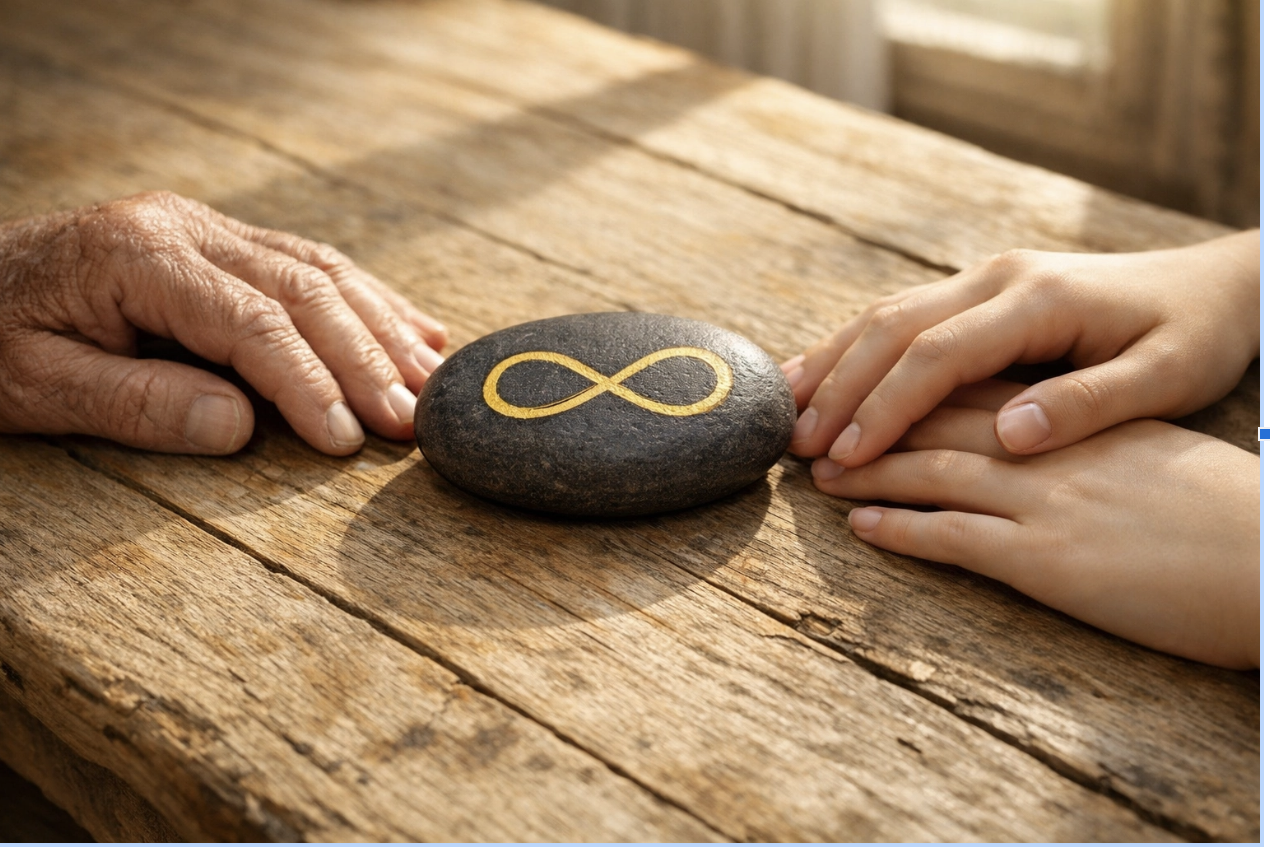
We don't use the puzzle piece here.
The puzzle piece implies something is missing.
It implies a person is a problem to be solved.
We use the infinity symbol.
Gold.
Resilient.
Never-ending.
It represents the infinite possibilities of the human brain.
It represents a connection that doesn't have a beginning or an end.
It is about Mission.
It is about purpose.
Honor the mind.
The Weight the Caregivers Carry
I know the parents.
I’ve been in the back of the ambulance with them.
I’ve seen the exhaustion etched into the corners of their eyes.
I’ve seen the way they advocate until their voices go hoarse.
They are the silent engineers of a more inclusive world.
They don't just hope for a better future; they build it with their bare hands every single day.
But even the strongest foundations need maintenance.
Even the fiercest warriors need a place to set down their armor.
We’ve talked about this in our Caregiver Reset.
You cannot pour from an empty cup.
You cannot lead the way if you are blinded by burnout.
Resilience isn't just about pushing forward.
It’s about knowing when to pause.
It’s about finding the "grit" to admit you need a moment of peace.
The strength of the spectrum isn't just in the individuals diagnosed.
It is in the community that surrounds them.
The families.
The teachers.
The therapists.
The first responders who take the time to learn how to de-escalate rather than dominate.
We are all part of the same fabric.
When one thread is pulled, we all feel the tension.
Care for yourself.
From Awareness to Acceptance
Awareness is the starting line.
It is knowing that autism exists.
But awareness alone is hollow.
It doesn't hire the neurodivergent worker.
It doesn't modify the classroom for the sensory-seeking child.
It doesn't stop the stares in the park.
Acceptance is the work.
Acceptance is moving from "I know" to "I am here."
It is recognizing that neurodiversity isn't a deficit.
It is an asset.
When we include autistic perspectives, we get better solutions.
We get more creative content.
We get deeper insights.
At REAL GRIT COMPANY, we believe in the power of lived experience.
We believe that the best stories are the ones told by those who have walked the path.
This is why we focus on Content Production that reflects the raw, unvarnished truth of the human condition.
We don't want the polished version.
We want the real version.
The one with the scars.
The one with the grit.
The world is finally starting to catch up.
We are moving toward a place where "inclusion" isn't a buzzword.
It is a requirement.
It is the standard.
Action over words.
The Humanity of the Struggle
There is a tendency to romanticize autism.
To talk only about the "savants" or the "geniuses."
That does a disservice to the reality of the spectrum.
Every life has value, regardless of its productivity.
Value is not measured by what you can do for the economy.
Value is inherent.
It is in the way an autistic child finds joy in the spinning of a wheel.
It is in the way an adult navigates a world that wasn't built for them and still chooses to participate.
It is in the resilience of the human spirit.
I’ve seen the struggles.
I’ve seen the meltdowns that aren't "tantrums," but the result of a nervous system under siege.
I’ve seen the isolation.
But I’ve also seen the breakthrough.
The moment of authentic connection that bypasses the need for spoken language.
The quiet strength of a person who knows exactly who they are, even if the world hasn't figured it out yet.
We are Built Not Born.
We are forged in the moments where we had to choose between giving up and giving more.
The autistic community has been giving more for a long time.
It’s time for the rest of us to meet them halfway.

A Shared Legacy
This April 2nd, don't just wear a color.
Don't just post a hashtag.
Look at your community.
Look at your workplace.
Ask yourself who is missing from the table.
Ask yourself how you can make the world a little less "loud" for someone else.
The Real Grit Foundation is built on the idea that we are stronger together.
That resilience is a team sport.
We carry the weight so others don't have to carry it alone.
This is the heart of what we do.
This is Gail’s story.
This is our story.
The spectrum isn't something to be "aware" of from a distance.
It is something to be part of.
To support.
To celebrate.
To defend.
The strength of the spectrum is the strength of humanity itself.
Diverse.
Complex.
Unbreakable.
Every life has value.
Every soul has grit.
We are one.
.


Caregiver Reset: The One Who Stays
Caregivers don’t clock out.
They don’t get applause.
They don’t get recognition for the quiet moments.
They just stay.

The chair isn't built for comfort.
It is a generic, vinyl-clad, hospital-issue throne of endurance. It creaks when you shift your weight. It bites into your lower back after the second hour. By the tenth hour, it feels like it’s trying to absorb you.
It is 3:00 AM.
The world outside has stopped, but inside this room, time has a different pulse. It beats to the rhythm of the monitors.
Beep. Hiss. Hum.
You are the one who stays.
You are the silent shift. The one who doesn't get a handover or a lunch break. The one who watches the IV drip and the rise and fall of a loved one's chest while the rest of the floor sleeps.
This is the reality of the caregiver. It isn't a highlight reel. It isn't a Hallmark card. It is raw, it is heavy, and it is exhausting.
But this is where grit is forged.
The Weight of the Silent Shift
In my years as an EMT and a First Responder, I’ve walked into thousands of these rooms. I’ve seen the faces of the ones who stay.
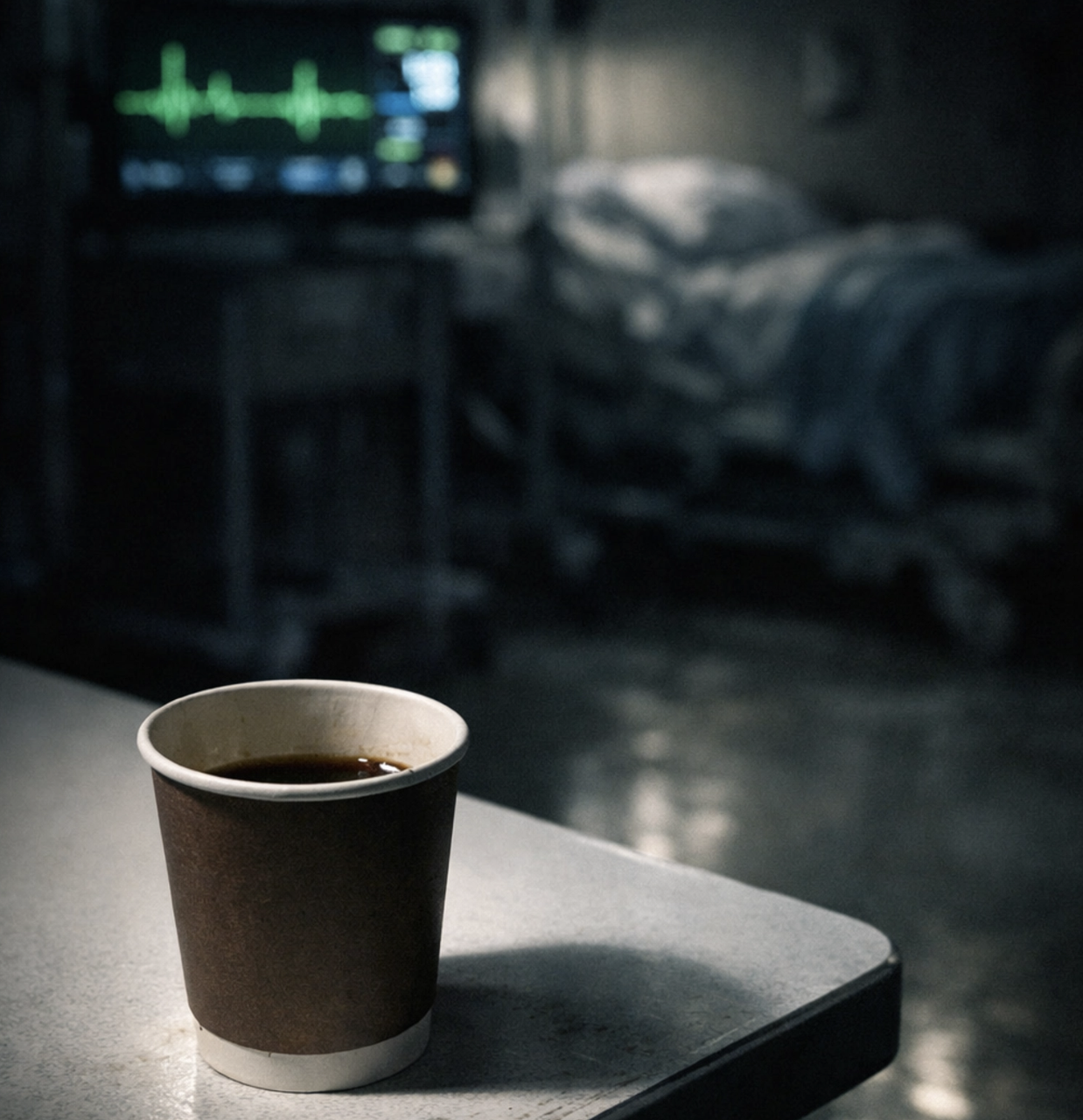
I’ve seen the way your eyes track the medical staff. I’ve seen the way you hold a hand: not just for their comfort, but for yours. I’ve seen the cold, half-empty coffee cup that has become a permanent fixture on the laminate side table.
That coffee is a symbol.
It was hot once. It was a moment of hope, a small luxury picked up in the cafeteria during a brief escape. Now, it’s just a bitter reminder of how long you’ve been sitting in that chair.
The silence of a hospital room at night isn't actually silent. It’s loud. It’s filled with the weight of "what ifs" and the clinical glow of monitors that never dim.
We talk a lot at REAL GRIT COMPANY about resilience. But resilience isn't just about the big battles. It’s about the quiet endurance of the middle-of-the-night watch.
It is about the strength required to remain steady when everything feels fragile.
I’ve held the clipboards. I’ve checked the vitals. I’ve been the one arriving in the ambulance. But I also know what it’s like to be the one left behind in the room when the sirens fade and the real work begins.
The work of staying.
Endurance is earned.
The Necessity of the Reset
You cannot pour from an empty cup.
It’s a cliché because it’s true. But when you are in "Hospital Mode," self-care feels like a betrayal. You feel like if you look away, something might happen. If you take a moment for yourself, you are failing the person in the bed.
That is a lie.
Survival mode is a short-term strategy. It’s meant for the sprint. But caregiving? Caregiving is the ultra-marathon.
If you don't reset, you break. And if you break, the person you are caring for loses their strongest advocate.
The "Caregiver Reset" isn't about a spa day. It’s about tactical emotional survival. It’s about taking five minutes: just five: to reclaim your own nervous system.
I call this the "Hospital Edition" reset. It’s built for the small spaces. It’s built for the person who can’t leave the room.
Tools for the Trenches
When I’m on a long shift, or when I’m sitting in that chair myself, I use specific tools to stay upright. These aren't theories. These are practices forged in the field.
1. Heart Coherence
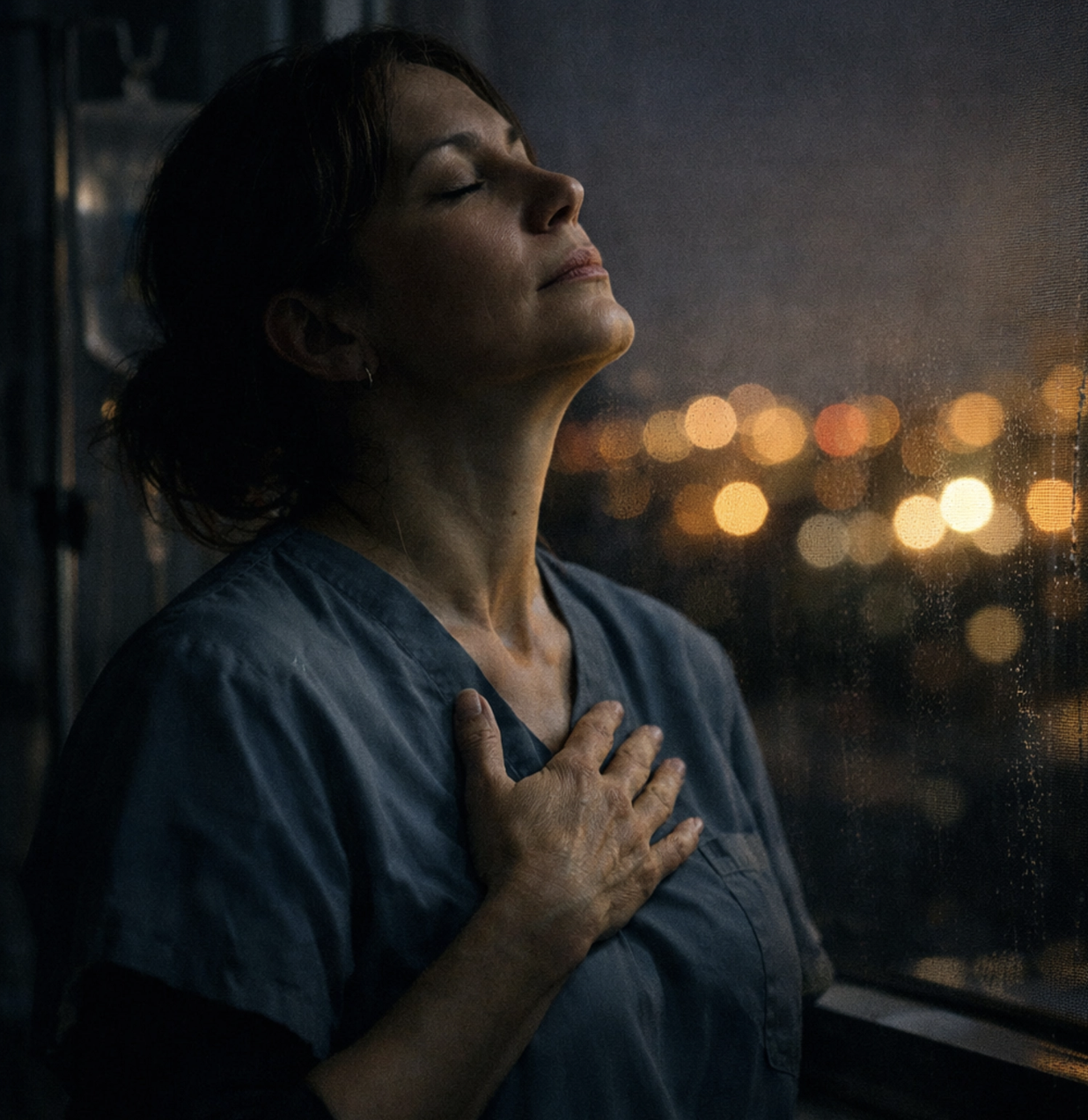
This is science, not fluff. When your heart rate is jagged from stress, your brain can't think clearly. You move into a state of "diffused energy."
Try this:
Breathe in for five seconds.
Breathe out for five seconds.
Focus your attention on the area around your heart.
As you breathe, try to feel a sense of gratitude or even just neutral stability.
Research from the HeartMath Institute shows this reduces anxiety and stabilizes mood. It tells your body: I am safe in this moment.
2. The 5-4-3-2-1 Grounding
The hospital room can start to feel like a vacuum. Your mind starts racing toward a future you can’t control. Pull it back to the present.
Name 5 things you can see (the dust on the monitor, the color of the blanket).
Name 4 things you can touch (the cold arm of the chair, the fabric of your shirt).
Name 3 things you can hear (the hum of the AC, the distant squeak of cart wheels).
Name 2 things you can smell (the sterile scent of alcohol wipes, your own coffee).
Name 1 thing you can taste.
3. The Physical Reclaim
Your body is holding the stress. It’s locked in your shoulders. It’s tight in your jaw.
Stand up. If you can’t leave the room, just stand by the window. Reach for the ceiling. Stretch your calves. Feel your feet on the floor.
You are a physical being, not just a set of worried thoughts. Reconnect with the machine that is carrying you.
Reset to remain.
Built, Not Born
There is a common misconception that caregivers are "born" with a special kind of patience.
That’s wrong.
Patience is a muscle. Endurance is a skill. You aren't doing this because it’s easy or because you were destined for it. You are doing it because it is required.
You are being built by this experience.
The person who walked into that hospital on day one is not the same person sitting in that chair tonight. You are tougher now. You are more observant. You have a deeper understanding of what it means to truly show up.
At REAL GRIT COMPANY, we believe that character is forged in the struggle. The "Real Grit" vibe isn't about being bulletproof. It’s about being tired, being raw, and staying anyway.
It’s about the "Quiet Endurance."
The Community of the Chair
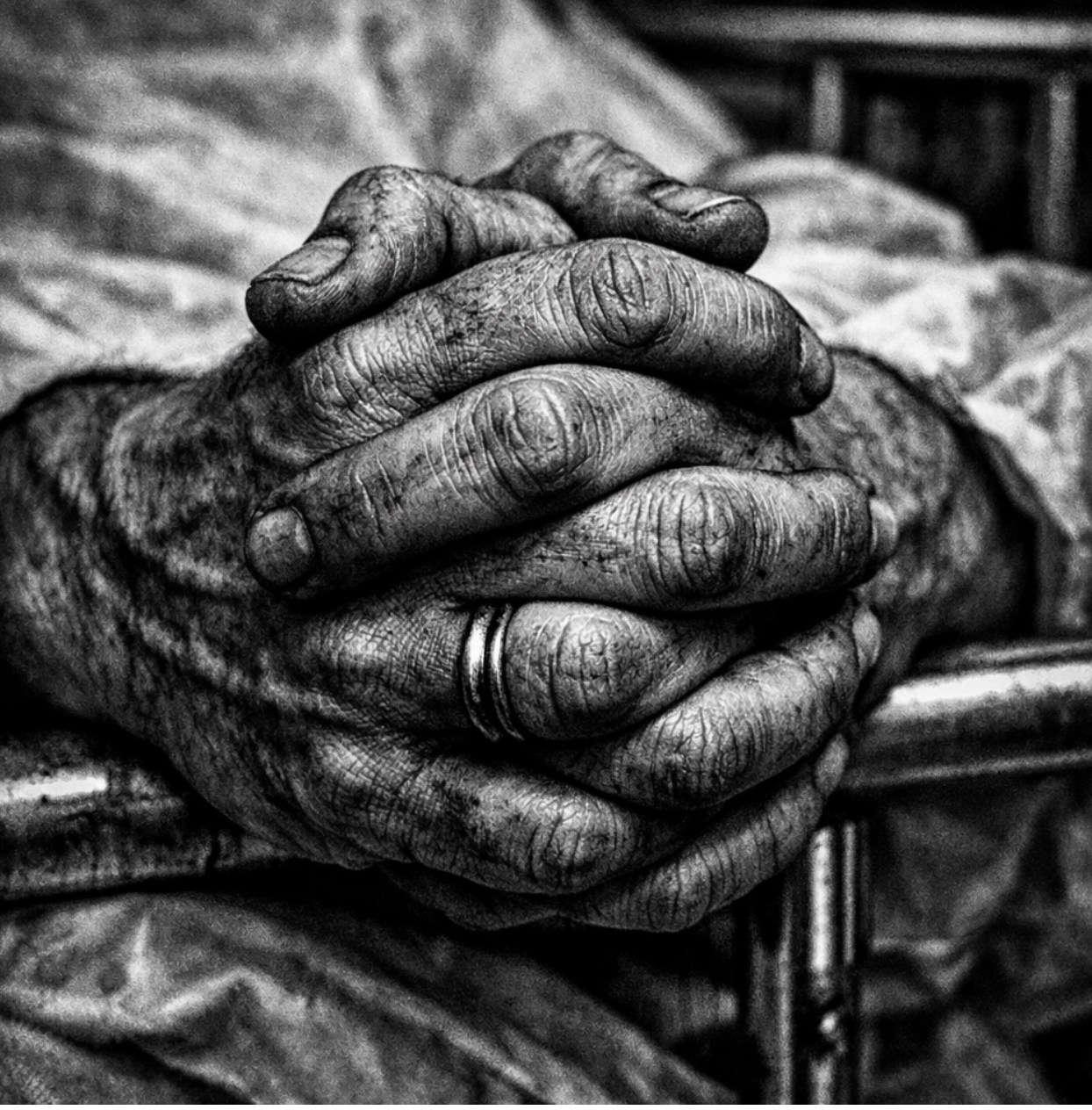
If you are reading this from a hospital room, know this: You are not alone.
There is a silent community of us. We are the ones who know the specific taste of hospital cafeteria eggs at 7:00 AM. We know the way the fluorescent lights make everyone look like a ghost. We know the feeling of the "silent shift."
We see you.
I’ve seen you in the hallways of the ER. I’ve seen you in the quiet corners of the ICU. You are the backbone of the recovery process. You are the advocate, the historian, the hand-holder, and the one who remembers the medications when the doctor asks.
Your role is vital.
But you must protect the asset. And the asset is you.
Don't let the cold coffee be the only thing keeping you going. Take the five minutes. Do the breathing. Stretch your back.
We need you to stay strong. We need you to stay gritty.
Final Thoughts from the Chair
The night is long, but it does end.
The sun will eventually hit the hospital windows. The shifts will change. The doctors will do their rounds.
Through all of it, you remain the constant.
This is your legacy. This is your purpose in this moment. It isn't loud, and it won't get a standing ovation, but it is the most important work you will ever do.
So, take a breath.
Square your shoulders.
Reset your mind.
The one who stays is the one who wins the long game.
Stay the course.

For more stories of grit and the reality of the front lines, read Gail’s Story.
Grit is earned.